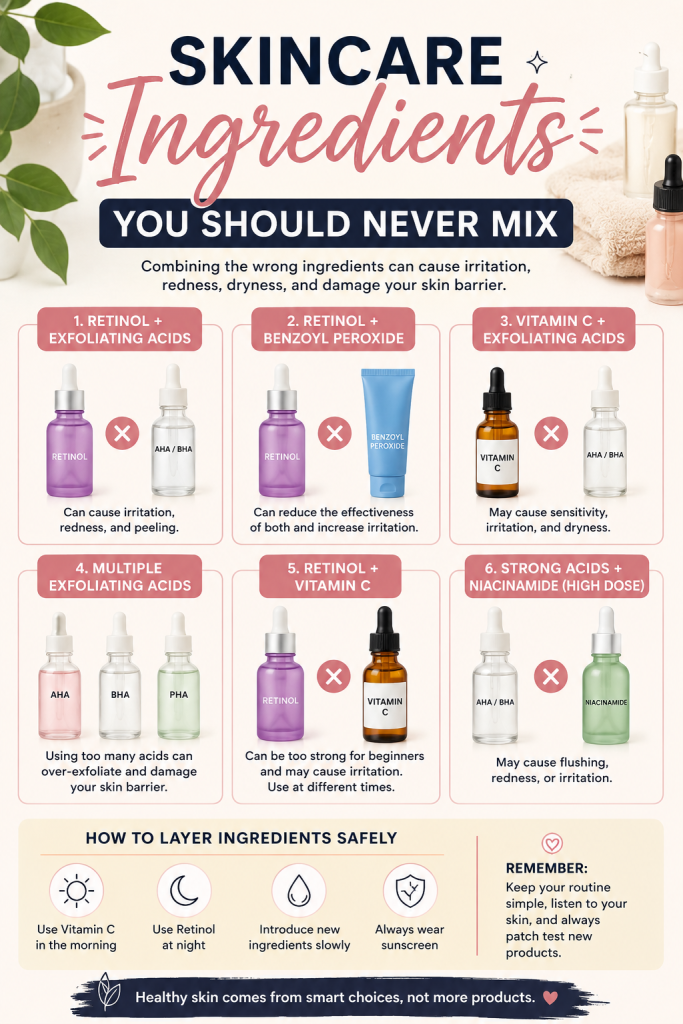
Discover which skincare ingredients should be avoided when used together. Discover common ingredient combinations to avoid, how to layer skincare products safely, and how to build an effective skincare routine.
A Beginner-Friendly Guide
Building a skincare routine can be exciting, especially when you start learning about popular ingredients like retinol, vitamin C, niacinamide, and salicylic acid. However, combining the wrong skincare ingredients can sometimes lead to irritation, dryness, redness, and a damaged skin barrier.
Fortunately, understanding which skincare ingredients should not be mixed can help you avoid common mistakes and build a safer, more effective routine.
In this guide, you’ll learn about skincare ingredient combinations to avoid, why some ingredients don’t work well together, and how to use active ingredients correctly.
Why Some Skincare Ingredients Shouldn’t Be Mixed
Not all skincare ingredients are incompatible. In fact, many ingredients work beautifully together. However, certain combinations can increase the risk of irritation, especially for beginners.
When too many active ingredients are used at the same time, the skin barrier may become overwhelmed. As a result, you may experience:
- Redness
- Dryness
- Peeling
- Sensitivity
- Burning or stinging
- Increased breakouts
Therefore, understanding ingredient compatibility is an important part of building a healthy skincare routine.
Retinol and Exfoliating Acids
Why This Combination Can Be Problematic
Retinol is a powerful skincare ingredient that supports skin renewal and improves skin texture. At the same time, exfoliating acids remove dead skin cells from the skin’s surface.
Common exfoliating acids include:
- Glycolic acid
- Lactic acid
- Mandelic acid
- Salicylic acid
Because both ingredients encourage skin turnover, using them together can significantly increase irritation.
What Can Happen?
- Dryness
- Redness
- Flaking
- Skin barrier damage
Better Approach
Instead of applying both products during the same routine, alternate them on different nights.
If you’re new to retinol, check out our Retinol Beginner Guide for tips on introducing it safely.
Retinol and Benzoyl Peroxide
Why You Should Be Careful
Benzoyl peroxide is a popular acne-fighting ingredient. While effective, it can be drying on its own.
When combined with retinol, irritation may become more likely, particularly for sensitive skin.
Better Approach
Many people choose to use benzoyl peroxide in the morning and retinol at night, or alternate them on separate days.
If you’re dealing with breakouts, our Acne Routine for Beginners provides a simple approach to acne-prone skin.
Multiple Exfoliating Acids
More Isn’t Always Better
Many beginners assume that using several exfoliating acids at once will produce faster results. However, combining multiple acids often increases the risk of irritation.
Examples include:
- Glycolic acid + salicylic acid
- Lactic acid + glycolic acid
- Salicylic acid + mandelic acid
Possible Side Effects
- Skin sensitivity
- Redness
- Tightness
- Damaged skin barrier
Instead, choose one exfoliating acid and use it consistently.
Vitamin C and Strong Exfoliating Acids
Why This Combination May Irritate Sensitive Skin
Vitamin C is a popular antioxidant known for brightening the skin and supporting a healthy-looking complexion.
However, combining vitamin C with strong exfoliating acids can sometimes increase sensitivity, especially for beginners.
Better Approach
Many skincare enthusiasts use:
- Vitamin C in the morning
- Exfoliating acids at night
This approach helps reduce the risk of irritation while allowing each ingredient to perform effectively.
For beginner-friendly recommendations, see our guide to the Best Vitamin C Serums for Beginners.
Retinol and Vitamin C
Can You Use Them Together?
Technically, yes. However, beginners may find the combination too irritating if applied during the same routine.
Both ingredients are highly active and can sometimes cause dryness when introduced too quickly.
Better Approach
A common recommendation is:
Morning:
- Vitamin C
- Moisturizer
- Sunscreen
Night:
- Retinol
- Moisturizer
This simple routine allows both ingredients to work without overwhelming the skin.
Retinol and Salicylic Acid
Proceed with Caution
Retinol and salicylic acid are both commonly used in acne skincare routines.
However, using them together may increase:
- Dryness
- Peeling
- Irritation
Better Approach
Alternate usage or introduce one ingredient at a time.
This is particularly important if you’re new to active ingredients.
Niacinamide and Vitamin C: The Myth Explained
Do They Really Conflict?
For years, people believed that niacinamide and vitamin C should never be used together.
Fortunately, modern research and improved formulations have shown that most people can safely use both ingredients in the same routine.
Benefits of Using Them Together
- Brightening support
- Skin barrier support
- Improved hydration
- Antioxidant protection
Therefore, this combination is generally considered safe for most skin types.
You can learn more about niacinamide in our guide to the Best Niacinamide Serums for Oily Skin.
Signs You’re Using Too Many Active Ingredients
Sometimes the issue isn’t one specific combination. Instead, it’s simply using too many active ingredients at once.
Watch for signs such as:
- Burning
- Stinging
- Excessive dryness
- Flaking
- Increased sensitivity
- Persistent redness
If these symptoms occur, simplifying your skincare routine can help your skin recover.
Our guide on How to Repair a Damaged Skin Barrier explains how to restore balance when irritation occurs.
How to Layer Skincare Ingredients Safely
Fortunately, building a safe skincare routine doesn’t have to be complicated.
Morning Routine Example
- Gentle Cleanser
- Vitamin C Serum
- Moisturizer
- Sunscreen
Evening Routine Example
- Cleanser
- Retinol OR Exfoliating Acid
- Moisturizer
Notice that only one major active ingredient is used at a time.
This approach is often ideal for beginners.
Tips for Introducing New Ingredients
Start Slowly
Introduce one active ingredient at a time.
Patch Test New Products
Testing products before full application can help identify irritation.
Give Products Time
Allow several weeks before evaluating results.
Prioritize Skin Barrier Health
A healthy skin barrier helps improve the effectiveness of your skincare routine.
Conclusion
Learning which skincare ingredients should never be mixed can save you from unnecessary irritation and frustration. While many ingredients work well together, some combinations may be too harsh, especially for beginners.
The key is to introduce active ingredients gradually, avoid overloading your skin, and maintain a simple routine focused on consistency rather than complexity.
Remember, healthy skin is built over time, and a balanced routine often delivers better results than using every trending ingredient at once.
Frequently Asked Questions
What skincare ingredients should never be mixed?
Common combinations that may increase irritation include retinol and exfoliating acids, retinol and benzoyl peroxide, and multiple exfoliating acids used together.
Can I use vitamin C and retinol together?
Many people prefer using vitamin C in the morning and retinol at night to reduce the risk of irritation.
Can I use niacinamide with vitamin C?
Yes. Most modern skincare formulations allow these ingredients to be used together safely.
Can I use salicylic acid and retinol together?
While some experienced users do, beginners may experience irritation. Alternating usage is often recommended.
What happens if I use too many active ingredients?
You may experience dryness, redness, peeling, sensitivity, and skin barrier damage.
How do I know if my skincare routine is too strong?
Signs include burning, stinging, excessive dryness, and persistent irritation.
Should beginners use multiple active ingredients?
It’s usually best to start with one active ingredient and gradually introduce additional products as needed.
What should I do if my skin becomes irritated?
Simplify your routine, focus on hydration, and consider reading our guide on repairing a damaged skin barrier.
Leave a Reply